Market Updates • July 28, 2026
Market Update・2026 Q2 Review



Market Updates • July 28, 2026
“The risk to the market in the second half is that so many parts are becoming increasingly reliant on a single theme.”
We hope you’re having an enjoyable summer. As someone who used to play soccer but rarely watches it, the World Cup has been more enjoyable for me than I thought it would be. Recently, I watched a World Cup match with someone who had never followed or played soccer. About twenty minutes in, they asked a reasonable question, “So…which team is better?” The answer was surprisingly difficult. One team had controlled possession, the other had created better scoring chances. One looked more organized, the other looked more dangerous. And the scoreboard—which is what everyone was watching—still read 0-0.
The eventual winner wasn’t decided until much later. A tired defender and one perfectly timed run changed everything. If you judged the teams after twenty minutes, you probably would have been wrong. If you judged them after ninety minutes, you might still have been wrong. Some of the greatest World Cup teams have gone home early. Some champions spent much of the tournament looking ordinary before finding their rhythm when it mattered most.
The lesson isn’t really about soccer, but how difficult it is to evaluate anything meaningful while it’s still unfolding.
Investors wrestle with this all the time. Every quarter feels important because it’s the part we’re living through, and every market move seems like it demands an explanation or represents a turning point. But a quarter is to investing what twenty minutes is to a World Cup tournament. The second quarter in markets was comparable to a very exciting first 20 minutes of a World Cup Match.
An AI story
After facing meaningful stress early in the year, mostly tied to the war in Iran and the surge in energy prices that followed, markets rebounded meaningfully in the second quarter, with the S&P 500 surging 15.2%.[1] That level of return puts it into the top decile of quarterly performance since 1990.[2]
Two things were true in the first half of the year. Artificial Intelligence (AI) led the market, and AI led the economy. On the market side, companies with exposure to the AI complex did most of the index’s work. On the economy side, the money allocated and spent to build AI infrastructure became one of the largest single contributors to real GDP growth.[3] This isn’t just exclusive to the technology sector as utilities, industrial and materials stocks have all benefited from the infrastructure demands for data centers. When one theme moves both the market and the economic data, you pay attention.
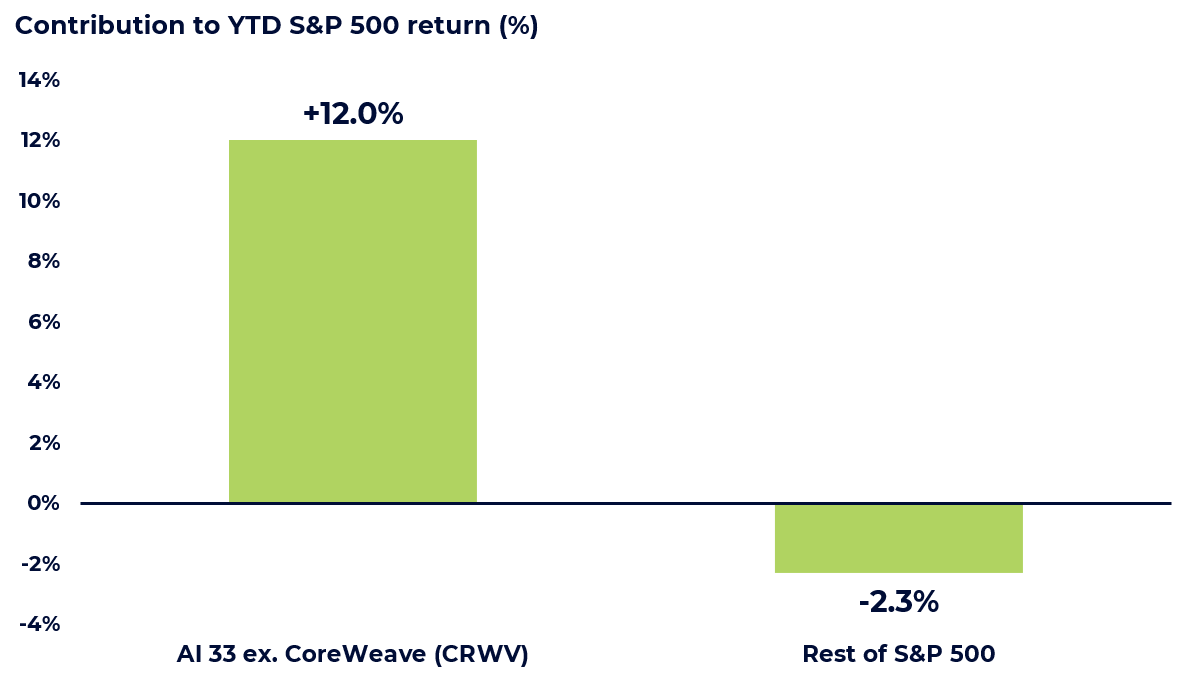
However, there’s a flip side to the story – returns are still overwhelmingly an AI story. Take the AI stocks out of the S&P 500 and what’s left is actually down through the first half.[4] In our view, the risk to the market in the second half is that so many parts are becoming increasingly reliant on a single theme. As such, and as part of managing risk, we’ve been diligent at trimming AI-related winners that have become oversized in portfolios.
Is this rally sustainable?
Clients have been asking us this question for years now. The short answer is that, historically, all-time highs often lead to further gains as long as corporate earnings continue to exceed expectations. After all, market price appreciation is very much linked to profit growth expansion. Corporate earnings in the second quarter were consistently strong and reinforced the view that fundamentals continue to support this bull market. Many of the companies beat earnings expectations and were rewarded. The more economically sensitive companies within technology, industrial, and financial sectors had particularly upbeat commentary.[5] This upcoming earnings season will be interesting to watch, as the bar is high. If earnings growth becomes stagnant or profit margins shrink, stocks will be more vulnerable to a selloff. The overall point we’d like to make, however, is that just because markets are near or at all-time highs, that doesn’t automatically make them fragile.
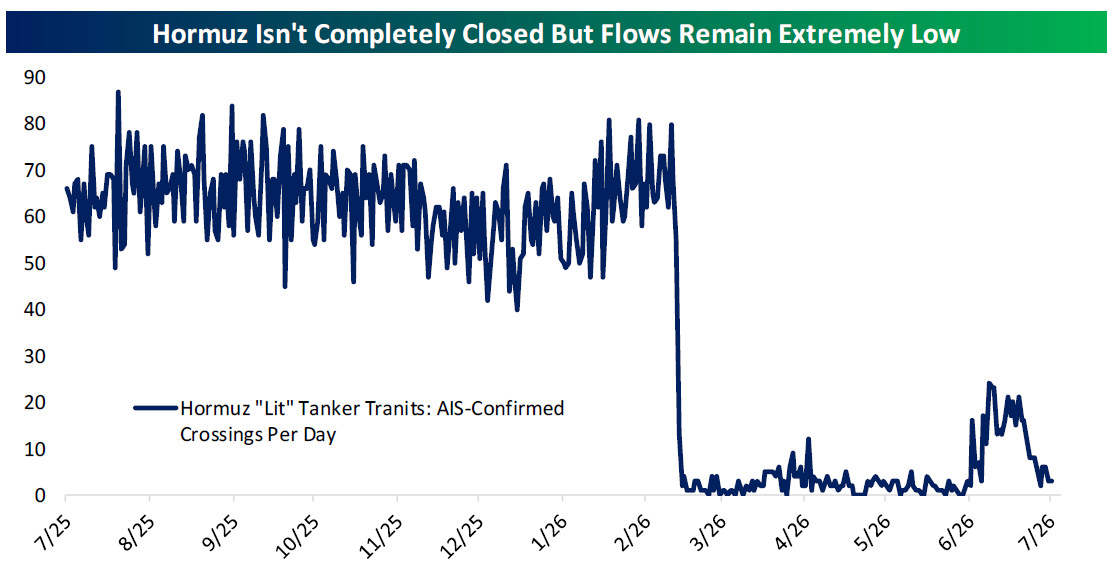
On the macroeconomic front, we would argue that the market continues to price in a best-case outcome as it relates to the reopening of the Strait of Hormuz. In the second quarter, markets repeatedly responded positively to signs that the US and Iran were moving closer to a resolution, with investors viewing a ceasefire as a catalyst for lower oil prices, lower bond yields, and improved earnings visibility. Any escalation of military activity could lead to little or no activity out of the Strait of Hormuz, resulting in higher oil prices which could spill over to higher inflation. Currently, we’re seeing tanker transits roll over towards the lows in March, April, and May.[6]
This dynamic could pose a conundrum for new Fed Chair Warsh who must now deal with balancing inflation risks against political pressures from the president to lower interest rates. The market continues to be in a tug-of-war between an earnings-driven AI boom on one side, and a higher inflation/more hawkish fed on the other.
Our strategy
The second half of the year begins with a high bar. Our responsibility to you is to own good businesses, remain diversified, avoid emotional decisions and stay invested through uncertainty. None of those ideas are new or overly exciting but, put together, they’ve created wealth for patient investors throughout many different market environments. That’s why successful investing has always been less about reacting to every possession of the ball and more about building a strategy that can succeed over the entire tournament.
As always, we’d like to thank you, our clients, for your continued trust, partnership and support. We’re here to address any questions or concerns you may have. In the meantime, we wish you and your family a wonderful remainder of the summer.
[1] Y-Charts July 1, 2026
[2] Bespoke June 29, 2026
[3] Dynasty Financial Partners July 15, 2026
[4] BlackRock, June 16, 2026. The AI 33 includes MSFT, ORCL, GOOGL, AMZN, CEG, SMCI, IBM, META, EQIX, UBER, CDNS, GEV, NOW, QCOM, DLR, PANW, CRWD, NXPI, VRT, DELL, LITE, AVGO, COHR, PLTR, HPE, ANET, NVDA, TSLA, AMD, MU, INTC, AAPL
[5] Natixis, June 25, 2026
[6] Bespoke July 17, 2026
DISCLOSURES
Great Diamond Partners, LLC is an investment adviser in Portland, Maine. Great Diamond Partners, LLC is registered with the Securities and Exchange Commission (SEC). Registration of an investment adviser does not imply any specific level of skill or training and does not constitute an endorsement of the firm by the Commission. Great Diamond Partners, LLC only transacts business in states in which it is properly registered or is excluded or exempted from registration. Great Diamond Partners, LLC’s current written disclosure brochure filed with the SEC which discusses among other things, Great Diamond Partners, LLC business practices, services, and fees, is available through the SEC’s website at: www.adviserinfo.sec.gov.
This information should not be considered investment advice. Opinions expressed reflect the judgment of the authors and are current opinions as of the date appearing in this material only. While every effort has been made to verify the information contained herein, we make no representation as to its accuracy and it should not be regarded as a complete analysis of the subjects discussed. All investing involves risk, including the loss of some or all of your investment.
Past performance does not predict future results.
Any indices and other financial benchmarks shown are provided for illustrative purposes only, are unmanaged, reflect reinvestment of income and dividends and do not reflect the impact of advisory fees. Investors cannot invest directly in an index. Comparisons to indexes have limitations because indexes have volatility and other material characteristics that may differ from a particular fund.
Certain information contained herein constitutes “forward-looking statements,” which can be identified by the use of forward-looking terminology such as “may,” “will,” “should,” expect,” “anticipate,” “project,” “estimate,” “intend,” “continue,” or “believe,” or the negatives thereof or other variations thereon or comparable terminology. Due to various risks and uncertainties, actual events, results or actual performance may differ materially from those reflected or contemplated in such forward-looking statements. Nothing contained herein may be relied upon as a guarantee, promise, assurance or a representation as to the future.
Specific investments described herein do not represent all investment decisions made by Great Diamond Partners, LLC. The reader should not assume that investment decisions identified and discussed were or will be profitable. Specific investment advice references provided herein are for illustrative purposes only and are not necessarily representative of investments that will be made in the future.
Hyperlinks in this piece are provided as a convenience, as we disclaim any responsibility for information, services or products found on websites linked hereto.
All investment strategies have the potential for profit or loss. Changes in investment strategies, contributions or withdrawals, and economic conditions may materially alter the performance of your portfolio. There are no assurances that an investor’s portfolio will match or outperform any particular benchmark. Asset allocation and diversification do not ensure or guarantee better performance and cannot eliminate the risk of investment losses.
Market Update・2026 Q1 Review