Market Updates • May 1, 2026
Market Update・2026 Q1 Review



Market Updates • May 1, 2026
“We believe that what you own matters far more than market exposure alone.”
As the second quarter begins, the war in Iran, now in its second month, remains the dominant economic story. It’s unclear how long the war will last, and markets have reacted accordingly.
US Equity markets broadened in the first quarter of 2026 as investors moved away from mega-cap technology stocks to other sectors.[1]
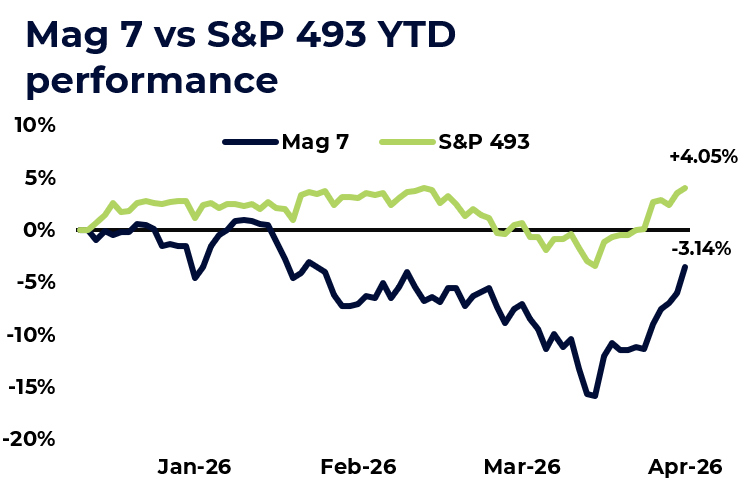
From our standpoint, this rotation is healthy and long overdue, with the average stock finally starting to pick up performance. The war stopped that rotation in its tracks as investors then piled into commodities and commodity-linked industries. Subsequently, stocks have declined steadily since the war began on Feb. 28. The S&P 500 fell 4.3% during the first quarter,[2] and the Nasdaq briefly fell into correction territory.[3] Volatility has risen as the market attempts to keep up with the rapidly changing global situation.
We’ll leave the military analysis to those who are qualified to do so. On the economic and markets front, the market now must confront a challenge that didn’t exist prior to the start of the war – the significant disruption of global energy markets. The war continues to restrict the flow of oil from the Middle East, pushing prices higher. Brent Crude, the global benchmark for oil, climbed more than 44% between Feb. 27 and the end of the quarter.[4] It remains unclear what continued conflict and damage in the region will mean for energy and the global economy, and investors worry about the downstream effects on inflation, consumer spending, and economic growth.
Navigating a Landscape of Unknowns
What happens next depends on a series of interrelated variables that are, by definition, unknowable.
In our view, an immediate resolution to the war could lead to a steep drop in energy costs, but a protracted war, with the Strait of Hormuz effectively closed, might push them to extreme highs. Whatever happens to energy prices will have a big impact on overall inflation. In turn, the outlook for inflation will affect Federal Reserve interest rate policy. On Feb. 27, the day before the war, Wall Street traders were expecting two to three interest rate cuts in 2026.[5] Now, a rate hike appears increasingly plausible.[6] Fed policy has big implications for the economy. While attempting to offset material rising inflation, rate hikes raise the cost of borrowing, which can cool economic growth.
Right now, it appears that the market is pricing in a quicker resolution to, at least, the economic impact of this war (Strait of Hormuz). The Trump Administration has proven to be acutely sensitive to market pain points over the last 18 months. Right around this time last year, that moment of frustration was the stock and bond market reaction to their “reciprocal” tariff plan announced on “Liberation Day,” which sent bond yields screaming upwards and stocks crashing. Days after, the administration announced a walk back of the tariff plan.[7] For now, the market believes that the administration will look for an off-ramp. If that belief fades, expect to see higher bond yields, higher oil and gas prices, and lower stock prices.
How Does the War Impact Portfolios?
As an individual investor, it can be tempting to try to interpret every headline and adjust your portfolio accordingly. But when the outcomes are unknowable, that approach is just guessing and gambling.
Even in more normal times, attempting to time the market and trade on evolving news is often a fool’s errand. The market is incredibly efficient, with stock prices already reflecting any information you might have. And any changes you might make reactively may introduce more risk than they remove.
Instead, consider why you’re investing in the first place. The goal isn’t to outsmart the markets today or tomorrow or the next day, but to improve your ability to build the life you want.
That’s why you have a financial and investment plan, driven by a process, designed to accommodate uncertainty. Diversification across asset classes, sectors, styles, and geographies helps manage the unknown by providing downside protection and maintaining upside potential.
Remember that investing, at its core, is an exercise in navigating the unknown. The future is unpredictable, and sources of long-term returns are rarely obvious in advance. In fact, it’s the uncertainty about the future that fuels stocks’ long-term growth potential: a stock’s return premium compensates investors for the risk of the unknown.
Evolving headlines will continue to create uncertainty in the weeks and months ahead. Through it all, keeping your portfolio aligned to your long-term goals gives you the best chance to achieve them.
Companies Evolve as Conditions Evolve
The corporate earnings picture doesn’t support a recession narrative. First quarter 2026 earnings growth is estimated to be 13.2% year over year, which would mark six consecutive quarters of double-digit growth. Combining that with valuations that have come down, along with forward company guidance well above average, we don’t see a setup for a recession.[8] However, we believe that what you own matters far more than market exposure alone. S&P 500 stock dispersion touched the 98th percentile during the first quarter, meaning the gap between winners and losers is wider than nearly any period in the last 30 years.
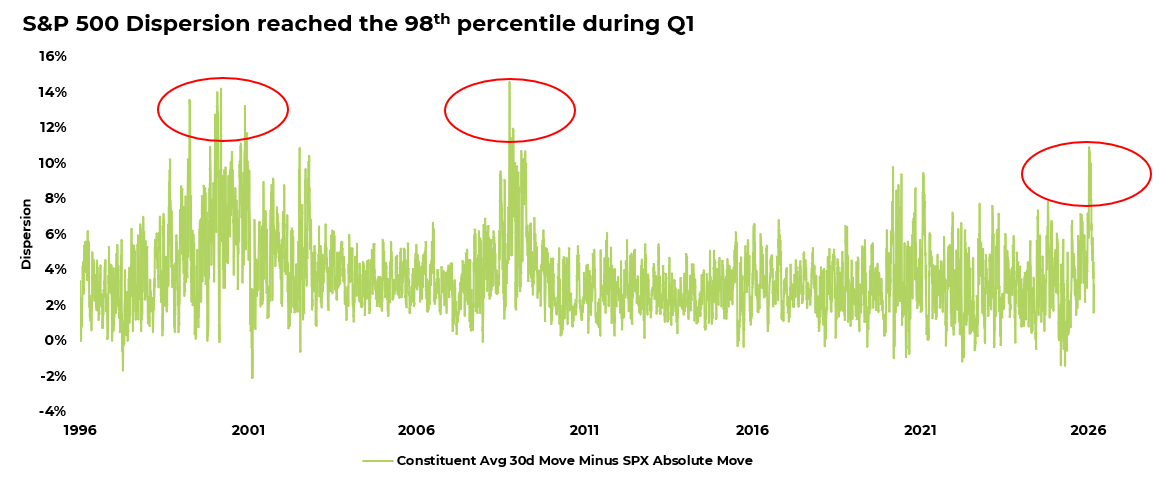
The prior peaks coincided with major regime shifts: the dot-com bubble, the Global Financial Crisis, and the post-COVID reopening.[9] Today’s drivers are AI and geopolitics creating structural shortages for key materials. Within stocks, themes such as electrifiction and grid buildout, datacenter construction, global defense, and aerospace should be the beneficiaries.
For fixed income, we consistently recommend staying inside bond maturity dates of seven years, suggesting that the marginal benefit received (yield) for the volatility risk taken (duration) diminishes as one extends further out the curve in most market conditions. The sensitivity of bond prices beyond seven years when facing changes in interest rates or issuer fundamental health is something we look to avoid. After all, fixed income, to us, represents a noteworthy tool to offset volatility within a portfolio; not something that adds to it.
As always, we’d like to thank you, our clients, for your continued trust, partnership and support. We’re here to address any questions or concerns you may have. In the meantime, we wish you and your family a wonderful spring.
[1] Bloomberg/Dynasty Financial Partners April 14, 2026
[2] Y Charts April 10, 2026
[3] https://www.schwab.com/learn/story/market-correction-what-does-it-mean A market correction is generally defined as an index declining by 10% but no more than 20%.
[4] Y Charts April 10, 2026
[5] https://www.cnbc.com/2026/03/20/fed-gov-waller-urges-caution-for-now-cuts-possible-later-in-the-year.html
[6] https://www.pbs.org/newshour/economy/chances-of-fed-cutting-interest-rates-fade-as-inflation-worsens
[7] Bespoke, April 9, 2025
[8] Bloomberg/FactSet/Dynasty Financial Partners April 2, 2026
[9] Bloomberg/Blackrock/Dynasty Financial Partners March 2026
DISCLOSURES
Great Diamond Partners, LLC is an investment adviser in Portland, Maine. Great Diamond Partners, LLC is registered with the Securities and Exchange Commission (SEC). Registration of an investment adviser does not imply any specific level of skill or training and does not constitute an endorsement of the firm by the Commission. Great Diamond Partners, LLC only transacts business in states in which it is properly registered or is excluded or exempted from registration. Great Diamond Partners, LLC’s current written disclosure brochure filed with the SEC which discusses among other things, Great Diamond Partners, LLC business practices, services, and fees, is available through the SEC’s website at: www.adviserinfo.sec.gov.
This information should not be considered investment advice. Opinions expressed reflect the judgment of the authors and are current opinions as of the date appearing in this material only. While every effort has been made to verify the information contained herein, we make no representation as to its accuracy and it should not be regarded as a complete analysis of the subjects discussed. All investing involves risk, including the loss of some or all of your investment.
Past performance does not predict future results.
Any indices and other financial benchmarks shown are provided for illustrative purposes only, are unmanaged, reflect reinvestment of income and dividends and do not reflect the impact of advisory fees. Investors cannot invest directly in an index. Comparisons to indexes have limitations because indexes have volatility and other material characteristics that may differ from a particular fund.
Certain information contained herein constitutes “forward-looking statements,” which can be identified by the use of forward-looking terminology such as “may,” “will,” “should,” expect,” “anticipate,” “project,” “estimate,” “intend,” “continue,” or “believe,” or the negatives thereof or other variations thereon or comparable terminology. Due to various risks and uncertainties, actual events, results or actual performance may differ materially from those reflected or contemplated in such forward-looking statements. Nothing contained herein may be relied upon as a guarantee, promise, assurance or a representation as to the future.
Specific investments described herein do not represent all investment decisions made by Great Diamond Partners, LLC. The reader should not assume that investment decisions identified and discussed were or will be profitable. Specific investment advice references provided herein are for illustrative purposes only and are not necessarily representative of investments that will be made in the future.
Hyperlinks in this piece are provided as a convenience, as we disclaim any responsibility for information, services or products found on websites linked hereto.
All investment strategies have the potential for profit or loss. Changes in investment strategies, contributions or withdrawals, and economic conditions may materially alter the performance of your portfolio. There are no assurances that an investor’s portfolio will match or outperform any particular benchmark. Asset allocation and diversification do not ensure or guarantee better performance and cannot eliminate the risk of investment losses.
Market Update・2026 Q2 Review